“"The ambition is not simply to replace one inspection method with another. It is to give infrastructure owners better-quality evidence about the condition of their assets, so emerging defects can be identified earlier and maintenance can be planned more intelligently. Conventional inspection can be slow and expensive, particularly where specialist access equipment, large teams and traffic management are required. If drones and advanced sensing can collect the information engineers need without always requiring the same level of on-site resource, there is potential to make inspections significantly more efficient. That could mean fewer hours spent on site, less disruption to transport networks and better use of engineering resources, while still giving asset owners the evidence they need to make informed maintenance decisions."
Drones and AI to Revolutionise UK Bridge Inspections
Birmingham City University research aims to cut costs and time for infrastructure maintenance using advanced technology.
By Tom Caulfield
••3 min read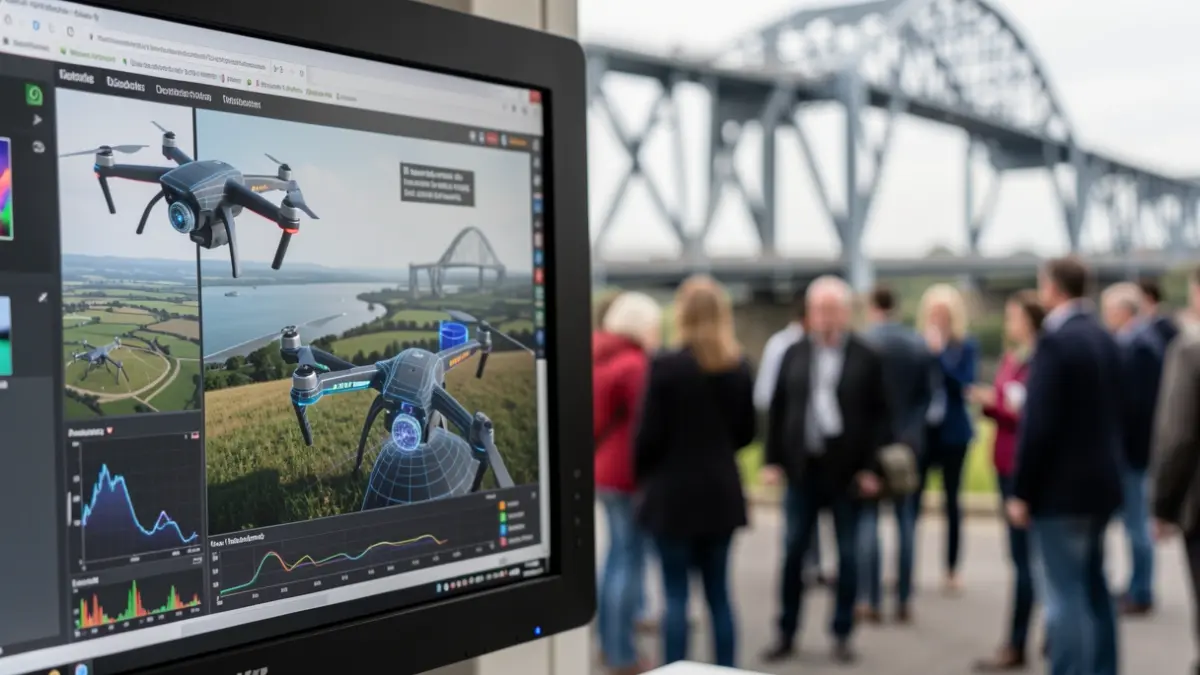
AI
Generic image of advanced drone sensors and AI data analysis interface on a computer screen, with blurred industrial bridge structures in the background.
Research at Birmingham City University (BCU) is exploring how drones, advanced sensing, and artificial intelligence could dramatically cut the time, staffing, and specialist equipment needed for bridge inspections.
The initiative is part of STRUCTURE, an international project costing €13.7 million and involving 21 partners from the UK, the Netherlands, Belgium, Portugal, and Türkiye. BCU is collaborating with drone technology firm Evolve Dynamics and National Highways to investigate the use of drones equipped with advanced sensors for identifying defects in masonry structures. This aims to provide engineers with improved data for maintenance decisions.
Masonry structures constitute approximately 40% of the UK's bridge stock, including around 18,000 bridges on the rail network alone. Conventional inspections can involve up to 10 people, require specialist access equipment like cranes and cherry pickers, and necessitate traffic management. A single inspection day can cost up to £25,000, with a full inspection potentially taking at least five working days, and preparation time tripling the overall duration. The potential savings for the UK's ageing bridge infrastructure are therefore substantial.
As part of the STRUCTURE project, Evolve Dynamics' uncrewed aerial system, WOLFE, will be fitted with advanced sensor payloads to gather detailed data remotely from masonry structures. BCU researchers will then apply algorithms and AI-driven analysis to this data, including developing automated crack detection and predictive maintenance tools. A digital twin platform will also be co-developed to consolidate inspection results and support maintenance planning.
National Highways will facilitate access to structures for real-world testing and validation. Professor Saeed Talebi, Professor of Digital Built Environment at BCU, stated, “We have been developing digital approaches to bridge inspection that bring together advanced sensing, data analytics and artificial intelligence. STRUCTURE allows us to take that research into real-world infrastructure and demonstrate what it can deliver at scale.”
This project builds upon BCU's existing research into the digital inspection and management of critical infrastructure. Previous studies have highlighted the potential of digital inspection to reduce the need for intrusive and hazardous conventional methods, while providing engineers with more detailed data. The STRUCTURE project is part of BCU's broader research programme focused on the digital inspection and management of transportation, tunnelling, and maritime infrastructure, integrating autonomous systems and artificial intelligence to create live digital twins.
Based on information from the official source: Birmingham City University (26/10/2026)